
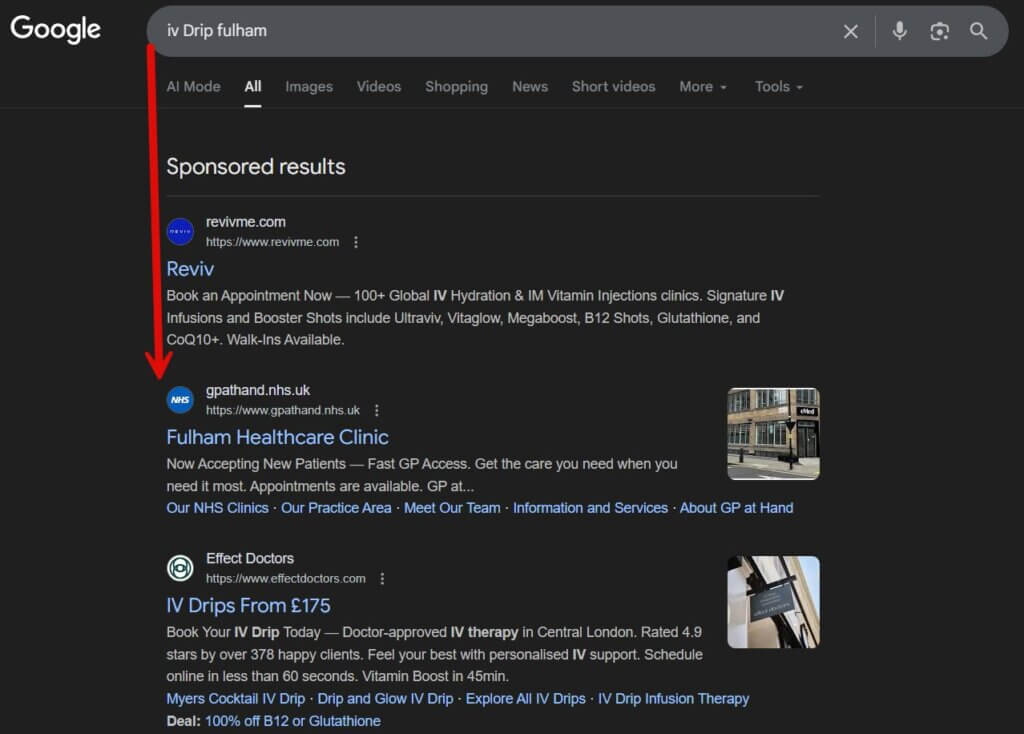
A curious result surfaced last week during a routine Google search for “IV drip Fulham.” Nestled between two private medical-aesthetics providers advertising vitamin infusions was an unexpected entry: an NHS-branded sponsored advert for Fulham Healthcare Clinic, part of the GP at Hand network.
The advert itself is not problematic in isolation. GP practices promote access, appointments and general healthcare information. But its placement alongside IV drip services, a category the NHS neither provides nor endorses, raises an uncomfortable question: why on earth is public money funding paid search placements on irrelevant, commercially-targeted keywords?
The screenshot shows three sponsored results:
- A well-known private IV drip chain promoting hydration and vitamin infusions.
- An NHS GP practice.
- A private doctor-led IV clinic offering B12, Myers’ cocktail infusions, and a range of wellness drips.
The NHS advert sits directly between two commercial services that sell IV therapy, a treatment category that, in the private sector, can cost hundreds of pounds and is marketed to wellness-seeking consumers. The NHS page, by contrast, focuses entirely on GP appointments, primary care, and general practice services. No vitamin infusions. No wellness drips. No elective hydration therapies.
The juxtaposition is stark, and the placement appears entirely accidental.
A Case Study in Keyword Mismatch
From a digital marketing perspective, the issue is clear. Keyword mismatch. Paid search ads rely on precise targeting to ensure ads appear in front of users actively searching for relevant services. When the targeting is poorly configured, for example, set to broad match without sufficient exclusions, ads can appear for loosely related or even completely irrelevant search terms.
In the commercial world, this results in wasted ad spend. In the public sector, it represents a direct leakage of taxpayer funds.
The search term “IV drip Fulham” is explicitly commercial. Everyone appearing in that results page except the NHS is selling something whether that is vitamin IV therapy, aesthetic infusions or wellness drips. These are not NHS services, nor are they adjacent to NHS care. Yet the NHS paid its way into this query as if competing with private wellness clinics.
This may seem trivial to some. A single advert on a single irrelevant search. But in PPC advertising, scale is everything. If the NHS’s ads are consistently being served on loosely connected wellness, aesthetic or private-health keywords in London, the cumulative cost could be substantial.
Two concerns emerge:
1. Public funds spent on unrelated services to The NHS
Every impression, click, or bidding event is funded by taxpayers. When those funds are directed toward keywords tied to services the NHS does not offer, the economic inefficiency becomes difficult to justify. Paid search algorithms optimise quickly; if clicks occur, Google may continue to reward and promote the ad, amplifying waste.
2. Risk of misleading or frustrating the public
A user searching for IV drip therapy, a private, elective treatment, is unlikely to be served by landing on a GP practice webpage. The mismatch not only wastes money but creates user friction, undermining confidence in the efficiency of NHS digital communications.
Competing With Private Clinics for a Product the NHS Does Not Sell
There is a deeper, more symbolic tension here. By appearing in paid search results alongside private wellness clinics, the NHS inadvertently inserts itself into a commercial environment that sits outside its mission and values. It also risks perceptions of promoting or endorsing IV therapies without providing them, a problematic position for a publicly funded healthcare system tasked with evidence-based practice and stewardship of limited resources.
Digital marketing teams typically configure paid search campaigns using combinations of broad, phrase and exact-match keywords. If “Fulham clinic,” “Fulham health,” “clinic near me” or similar phrases were used with broad match settings, the Google algorithm may have decided “IV drip Fulham” was close enough to display the NHS advert.
The missing safeguard would have been negative keywords, blocks that prevent ads from appearing on irrelevant searches. Common exclusions in healthcare campaigns include terms like “Botox,” “filler,” “laser,” “IV drip,” or “aesthetic,” unless those services are explicitly offered.
The NHS ad appearing on this page suggests those exclusions may not be in place, or that the campaign is set too broadly.
This isolated screenshot reflects a pattern seen across many public-sector PPC campaigns: generous budgets, broad targeting, and insufficient manual oversight. With millions spent annually on digital advertising by public bodies, even modest inefficiencies can scale into significant waste.
In an era when NHS resources are repeatedly described as stretched to the edge, seeing money redirected toward competing for irrelevant Google searches will strike many as a preventable oversight, a technical error with ethical implications.
The appearance of an NHS sponsored advert under a commercial “IV drip Fulham” query is not a scandal in itself. But it is a window into something larger: how misconfigured digital advertising campaigns can quietly drain public funds while delivering little public value.
At a time when NHS budgets face enormous scrutiny, this kind of keyword mismatch, subtle, technical, but financially real, deserves closer attention and a reassessment of how public health campaigns are managed in the search economy.
If you want to avoid this type of wastage, public or private, speak to one of our Google Ads experts today.