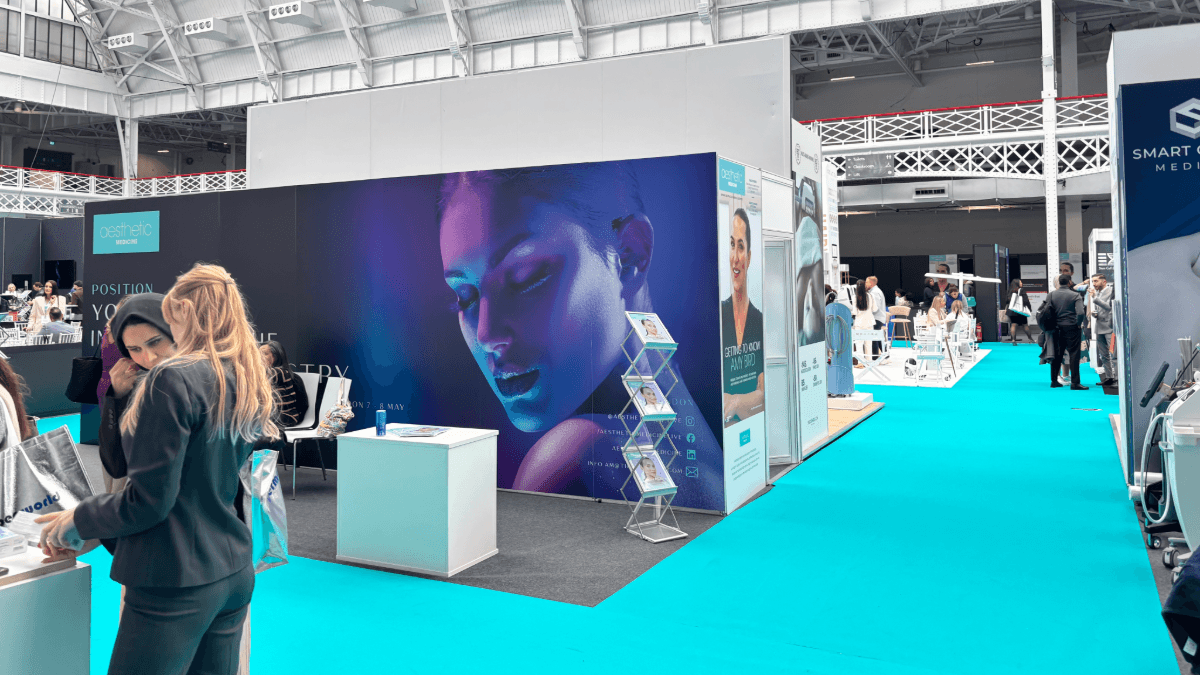
Based on interviews recorded at Olympia, Kensington, 8–9 May 2026
The most important insight from Aesthetic Medicine London 2026 was not any single product launch, device, or practitioner soundbite. It was the pattern that emerged when those conversations were read together. Across brands, doctors, educators, and clinic operators, the market appears to be reorganising itself around a new commercial logic.
Patients want results that look more natural, clinics want margins that are more defensible, and both are increasingly drawn to models built on regeneration, proof, safety, and long-term trust. In other words, the aesthetics market is becoming less about selling isolated treatments and more about building complete treatment ecosystems, educational narratives, and brand credibility.
Trend Categories at a Glance
- Regenerative & Combination Treatments: The market is moving from single interventions to layered treatment plans that promise better tissue quality, longevity, and higher perceived sophistication.
- Natural Results & Patient Demand: Patients still want visible change, but they increasingly want it framed as refinement, restoration, and prevention rather than obvious intervention.
- Diagnostics, Evidence & Consultation Tools: Scanning, analysis, and measurable proof are becoming commercial tools as much as clinical tools.
- Clinic Business Models & Monetisation: Clinics are looking for stronger retention, better margin control, and more ownership over what happens after the consultation.
- Content, Social Media & Reputation: Trust is shifting away from flashy immediacy and toward transparent, longer-horizon proof of outcomes.
- Safety, Trust & Regulation: Medical authority is no longer a background credential; it is becoming a frontline marketing asset.
Read literally, the Aesthetic Medicine London 2026 interviews, conducted in collaboration with Digital Aesthetics CEO Kostas Alekoglu and the Aesthetics Today podcast, covered exosomes, polynucleotides, skin scanners, skincare, lip-focused products, social media, clinic expansion, and regulation. Read strategically, however, they revealed a more important shift. Aesthetics is entering a phase of consolidation and maturity. The market is no longer driven purely by novelty. It is being reorganised around three commercial pressures at once, patient scepticism, intensifying competition, and the need for clearer differentiation.
That is why so many conversations, even when they appeared to be about very different products, kept circling the same underlying themes. A DermapenWorld representative discussed technology and quality. Dr Cemal Kavasogullari focused on smart treatment stacking and objective assessment. Dr Kai emphasised skin-specific protocols and tailored care. Dr Steven Land returned repeatedly to realism, reputation, and better content. Alexandra Mills, One Planet, PRP Pure, Monica Heiligmann, and 5 Squirrels each, in different ways, pointed toward the same market direction: the winners in 2026 will not be the businesses that shout the loudest about trends, but the ones that translate complexity into clarity and trust.
The interviews suggest that regeneration is no longer a niche add-on category; it is becoming the organising idea of modern aesthetics. Whether the discussion was about polynucleotides, PRP, amino acids, exosomes, skin quality, wound healing, or tissue support, the commercial message was strikingly consistent: the market increasingly values treatments that appear to work with the body’s biology rather than simply override it.
This matters because regenerative language solves two marketing problems at once. First, it helps clinics align themselves with the growing patient preference for results that feel intelligent rather than excessive. Second, it allows brands and practitioners to position treatment plans as medically considered, premium, and progressive. That creates more room for value-based pricing. When a clinic is not merely selling filler or microneedling but a broader regenerative strategy, it is no longer competing only on the basis of unit price. It is competing on philosophy, planning, and expertise.
The implication for Digital Aesthetics is that content should not treat regenerative treatments as individual fads. The real story is that clinics are building an entire commercial vocabulary around regeneration. That shift affects menus, consultation flow, staff training, website structure, and how practices explain premium fees.
Packages & Combos
Another pattern running through the interviews is that the market is moving away from the old model of isolated, single-session treatments and toward carefully layered programmes. This is larger than the popularity of “combination therapy” as a phrase. It suggests that aesthetics is becoming more systematised.
When practitioners speak about stacking treatments intelligently, what they imply is that the patient journey is being restructured into a sequence of complementary interventions rather than a menu of unrelated purchases. That is a major commercial development. It increases average order value, creates a stronger rationale for multi-step plans, and gives clinics more scope to own the long-term patient relationship. It also changes how marketing must work. A website built around disconnected treatment pages will increasingly underperform against a clinic that explains how different technologies work together to solve a larger problem.
In practical terms, this means the most effective clinic marketing in 2026 is likely to move away from listing treatments one by one and toward problem-led pathways: skin rejuvenation after inflammation, neck and jawline contouring, post-weight-loss facial restoration, scar recovery, or long-term skin quality planning. Combination therapies are not just a clinical technique. They are a packaging strategy.
One of the most commercially significant implications in the interviews is that filler has not disappeared; its cultural meaning has changed. The market appears to be moving away from filler as a symbol of obvious aesthetic intervention and repositioning it as one component within a more sophisticated restorative framework.
That distinction matters. For years, many clinics built growth on the visibility of treatment. In the current environment, visibility can work against credibility. The new premium signal is not that something has clearly been done, but that the patient looks fresher, structurally supported, and more credible in their own skin. Practitioners such as Dr Steven Land and Alexandra Mills imply that patients still want volume correction when it is necessary, particularly in cases such as GLP-1-related facial hollowing, but they increasingly want it contextualised within a broader narrative of natural restoration.
This creates an important marketing opportunity. Clinics do not need to abandon filler-led revenue; they need to reposition it. The strongest messaging will frame filler as selective, strategic, and integrated, not excessive, routine, or identity-defining. In branding terms, the market is moving from transformation theatre to calibrated intervention.
The enthusiasm around scanners and objective skin analysis points to something bigger than interest in new devices. It suggests that evidence is becoming part of the conversion process itself. In a more crowded and more sceptical market, clinics need tools that make invisible problems visible and abstract claims measurable.
That is why diagnostic technology now matters commercially. It gives clinics a more authoritative consultation, helps justify treatment plans, and creates content assets that can be reused across the patient journey. A scan is not only a piece of data. It is a way of translating expertise into something the patient can see and understand. It reduces friction in high-value sales because it makes the recommendation feel less subjective.
For us, this is an important editorial angle. The scanner story is not simply about whether a new machine is impressive. It is about how consultations are being redesigned to feel more evidence-led, more premium, and more defensible. In a market where trust is fragile, proof has become part of the product.
Dr Kai’s discussion of skin of colour has implications well beyond one clinical niche. It points to a broader truth about the future of aesthetics marketing. Generic messaging is becoming commercially weaker. Patients increasingly expect specificity, and specificity signals competence.
In practical terms, clinics that can clearly explain how treatment protocols differ by skin type, inflammatory response, downtime profile, or aftercare need will outperform clinics that still market everything as universally suitable. This is not only an ethical or clinical issue. It is a positioning issue. Inclusive expertise helps a clinic move from sounding broad to sounding trustworthy.
The larger implication is that the next phase of clinic marketing will reward depth over generality. Website copy, blogs, consultation pages, and social media will need to show that the clinic understands the nuance of different patient groups. That is how authority is built now: not by claiming to treat everyone the same way, but by showing why different patients require different pathways.
One of the clearest commercial signals from the interviews was that clinics are thinking more seriously about ownership, retention and lifetime value. The conversation around private-label skincare is especially important, not simply because it concerns products, but because it exposes a growing frustration with weak post-consultation monetisation.
If a clinic educates a patient, wins their trust, prescribes a regimen, and then loses the sale to e-commerce discounting, the clinic has financed demand without capturing enough value. That is unsustainable in a market where acquisition costs are rising. Private-label models, curated regimes, and clinic- controlled retail ecosystems are all attempts to solve the same problem, how to retain commercial ownership after the consultation ends.
More broadly, the interviews suggest that clinics are becoming more operationally ambitious. Expansion plans, device support models, and more structured business infrastructure all point to a market that is professionalising. This is not just an industry of lone injectors anymore. It is increasingly an industry of brands, teams, systems, and capital decisions.
Several interviews imply that content itself is now a proxy for clinical credibility. The market is tiring of exaggerated before-and-afters, performative live treatment moments, and visuals that create excitement but not understanding. In their place, a more mature style of content is emerging, longer-view documentation, educational explanation, and proof that is less immediate but more believable.
This is highly significant for the Digital Aesthetics blog and for clinic marketing more broadly. In a noisy marketplace, the brands that win attention are not always the brands that win trust. Trust increasingly belongs to those who can explain what they are doing, why they are doing it, who it is suitable for, and what results look like over time rather than in the treatment room. That is a very different content model from the one aesthetics relied on during the social-media growth years.
The strategic implication is that clinics need editorial depth, not just visual output. They need case-based stories, treatment rationale, outcome timelines, philosophy statements, and educational framing that turns attention into confidence. Content is no longer just a lead-generation tool. It is becoming part of due diligence for the patient.
Reputation, Reputation, Reputation
One of the strongest implied themes in the interviews is that premium reputation increasingly comes from discernment. In earlier phases of the industry, growth often came from being available, visible, and willing to deliver what the patient requested. In the current phase, the stronger brands seem to be those that place boundaries around what they will and will not do.
This is commercially powerful because refusal creates signal. It communicates standards, taste, confidence, and a longer time horizon. Clinics that openly prioritise natural outcomes, realistic treatment planning, and appropriate patient selection are not just reducing risk; they are strengthening brand position. They are telling the market that they are not in the business of transaction alone.
For a marketing agency like Digital Aesthetics, this is where the best business story sits. The future of premium aesthetics may not belong to those who promise the most, but to those who edit the most carefully, clinically, visually, and commercially.
The discussions around regulation, medical training, and complication management imply another major shift. Safety is no longer merely something clinics need to have in place. It is becoming something they need to articulate.
In a market where non-medical competition, inconsistent standards, and patient anxiety all coexist, safety becomes a central brand asset. Medical credentials, emergency preparedness, aftercare capability, and the ability to manage complexity all help justify premium positioning. This is particularly relevant when clinics are asking patients to commit to larger treatment plans or more advanced technologies. The bigger the treatment proposition, the more the patient needs to believe in the governance around it.
The interviews imply that safety and sophistication are no longer separate stories. In the 2026 market, they are increasingly the same story.
Another meaningful implication from the interviews is that innovation still appears to move outward from London, but competitive advantage does not come only from being first to hear about a trend. It comes from being first to translate it for a specific audience.
That is an important distinction for regional clinics and for industry media. A new treatment category can be visible in London long before it becomes commercially legible elsewhere. The gap between those two moments is where strategic media matters. Clinics outside the capital do not simply need awareness of trends; they need help turning trends into language their local market understands and trusts.
This is exactly where the Digital Aesthetics can add value. Our role is not only to report what was seen on the exhibition floor, but to interpret what those conversations mean for clinics trying to make decisions about positioning, patient demand, pricing, and future investment.