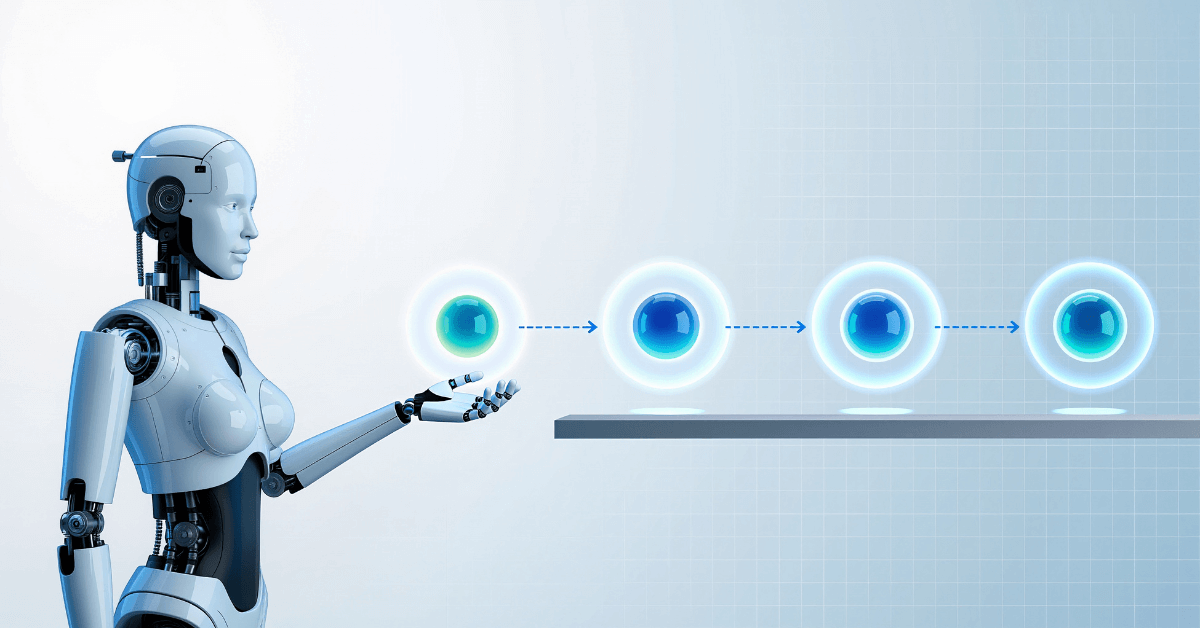
The concept of artificial intelligence has roots that stretch back centuries. In Ancient Greece (around 700 to 300 BCE), myths featured artificial beings such as Talos, a giant bronze automaton forged by Hephaestus. By the Medieval period (around the 1200s), inventors were creating early mechanical automata designed to mimic living creatures.

And the idea took a major step toward modern AI in 1950, when Alan Turing published Computing Machinery and Intelligence and introduced the Turing Test (one of the first formal arguments that machines could potentially think).
However, AI as we know it today has advanced far beyond the futuristic fantasies of The Jetsons. The 2000s marked a significant shift in artificial intelligence, moving away from hand-coded “expert systems” toward machine learning, where algorithms could learn directly from data rather than relying on manually written rules.
Plus, as the internet exploded, companies accumulated massive amounts of data. Combined with more powerful GPUs (Graphics Processing Unit) and cheaper computing, this created the conditions AI needed to flourish.
But in the year 2026, what does AI mean for you, your clinic, and your marketing? What is fact, and what is fiction? Let us talk about it.
What AI Means In The Modern World
Putting the Terminator and Talos aside, AI today refers to digital systems that can perform tasks that typically require human thinking. This can include anything and everything from analysing data, recognising patterns, making predictions, and even generating content. But more importantly, it also goes far beyond simple automation. It has become a strategic tool that enhances decision-making, improves efficiency, and creates personalised experiences at a grand scale.
However, as glorious as it sounds, it has its benefits, and it does have its downfalls. For example, overdoing it with AI can make your marketing sound exactly the same as everyone else’s. How does that help you stand out from your competitors? It does not!
So, when to use it, and when not? That is the million-dollar question. Let us commence.
Benefits vs. Disadvantages Using AI In Your Marketing
| Aspect | Benefits Of Using AI In Marketing SOLO | Disadvantages Of Using AI In Marketing SOLO |
| Efficiency | Automates repetitive tasks like email campaigns, social media posting, and ad optimisation. | Relying too heavily on AI can stifle human creativity and intuition, which are crucial for crafting campaigns that truly resonate with audiences and optimise SEO performance. This is why partnering with a marketing agency is essential, they provide the human touch that ensures strategy, storytelling, and engagement go beyond what AI alone can achieve. |
| Personalisation | Can deliver highly personalised content and product recommendations to users. | While privacy concerns can arise if personal data is misused due to AI, a marketing agency like ours (deeply committed to adhering to advertising regulations and optimising within Google’s algorithms), can use AI responsibly to help your clinic thrive and reach new heights. |
| Predictive Marketing | Forecasts customer behaviour, enabling proactive marketing strategies. | While predictions can be off if data quality is poor, this is exactly where we excel. We meticulously analyse our clients’ data to ensure every decision is accurate, strategic, and drives outstanding results. |
Let’s Talk About Chatbots
Chatbots are gold for any aesthetic clinic or medical practice. Guess what, they are AI too! Chatbots can answer common questions at any time, like clinic hours, services offered, or insurance details. This saves your clinic, you, and your staff, a ton of time. These bots also help reduce patient frustration from waiting on hold or trying to reach staff outside business hours.
Patients can also book, reschedule, or cancel appointments directly through a chatbot. So short story long, chatbots can help minimise administrative workload for reception staff and reduce scheduling errors.
Will AI Replace Your Clinic Though?
Over the last year, one question has been coming up again and again in conversations with aesthetic-clinic owners: “Is AI taking over, and more so, is it going to take over on its own?”
And it is an understandable concern. The beauty and medical-aesthetics industry is moving fast, competition is rising, and new digital tools seem to appear every week. Many clinic owners worry that if they do not master AI immediately, they will be left behind. Others fear that AI will replace their human touch or the personalised relationships they have built with patients.
So, is this true or not true? And is it something to worry about? The way we see it, AI is not something that will “happen on its own.”
Why? Because it is a tool, not a takeover, and it only works when you choose to apply it strategically. For aesthetic clinics, AI can become a massive competitive advantage, but only when used with intention, clarity, and guidance.
Remember, the aesthetic industry is uniquely positioned in a space where medical expertise, artistic talent, and high-touch care intersect. Not to mention, clinic owners are passionate practitioners.
However, they are also business owners, juggling marketing, branding, operations, and patient experience. That is why AI can feel overwhelming, because keeping up with technology is tough enough as it is. And when it comes to AI, it is difficult to fully grasp what matters and what does not at times. What content should you promote, or on that note, what content should you be writing?
So when clinic owners ask whether AI will “just happen,” what they are really asking is:
- Do I need to do something now?
- Will this replace me?
- How do I know what tools to choose?
- Where do I even start?
And in short, no, it is not going to run your clinic. It cannot inject filler or build trust the way a human can. Because patients choose aesthetic treatments not just for results but for the expertise, safety, and connection provided by their practitioner, things no algorithm can replicate.
… But clinics using AI may outperform those who do not.
How A Marketing Agency Can Help Your Clinic Shine with AI
It is important to note that AI is not automatic, meaning you control it. Because, one of the biggest misconceptions around AI is that it will “take over” all on its own.
Clinics that learn how to integrate AI intelligently are seeing higher lead conversion, more consistent content output, better patient education, reduced administrative workload, faster response times, and more personalised marketing. For example, many companies that use AI correctly can cut costs by up to 30%, especially for repetitive tasks. Plus, businesses that integrate AI across their operations often see over 60% revenue growth and better decision-making and efficiency.
But, in reality, AI has no initiative, no business strategy, and no understanding of your brand or values. It also cannot grow your revenue without clear direction. Just like a laser device does not deliver results without a skilled practitioner, AI will also not generate outcomes unless someone is guiding it.
If you are worried about being “behind,” do not be. This is where a specialised marketing agency like ours becomes invaluable.
A strategic agency can help you:
- Choose the right AI tools for your clinic
- Produce consistent, on-brand content using AI
- Automate your marketing without losing your brand voice
- Build AI-powered patient journeys that increase conversions
- Save time by handling the tech so you can focus on treatments
- Analyse your data so you understand what is working (and what is not)
In other words, an agency like ours does not just give you AI tools; it ensures those tools work for you (and thus your clinic). The result: a stronger brand, smoother operations, and a clinic that stands out effortlessly in a competitive market.